

New BBBEE research launched
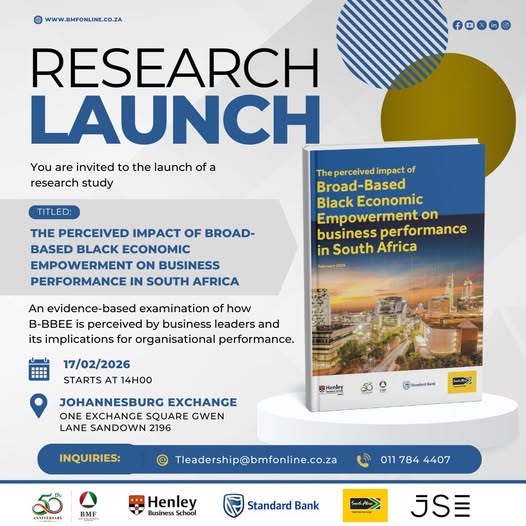
As the Black Management Forum (BMF) approaches its 50th anniversary, a major new research report released in partnership with Henley Business School Africa, supported by Standard Bank and Brand South Africa, has issued a definitive challenge to business and government: B-BBEE remains vital to economic transformation, but in its current form, it is failing to impact business performance. The report, titled The perceived impact of Broad-Based Black Economic Empowerment on business performance in South Africa, surveyed over 500 managers to gauge the real-world impact of transformation policies. The consensus is clear: while the spirit of economic inclusion is broadly accepted and endorsed by South African business leaders, the current ‘tick-box’ mode of implementation is failing to deliver genuine economic justice.
‘The democratic dividend of 1994 was not a moment of complete transformation, but only the
beginning of real change, which was meant to be accompanied by clear commitment to
creating a new economic landscape of which B-BBEE was a core component, B-BBEE and affirmative action are the firstborn children of ubuntu in the economy, which is the unique philosophical grounding that seeks to embrace and see the humanity in us all. Without B-BBEE, we will miss the core of humanity, and it is time that we correct the perceptions around it. Nevertheless, it is clear that this vital policy
may not be working as well as we need it to.’ says Monde Ndlovu, MD of the Black Management Forum.
‘B-BBEE legislation was established with a specific and critically important objective of
economic transformation and redress in mind, and this research is offered to inform
democratic debate as to whether it is still fit for purpose, and if so, how to improve it. The evidence from this report suggests that B-BBEE works best where it is implemented with genuine intent, rather than as a compliance burden. We aim to provide vital data points to ensure we can target effective reforms to the policy, finding impacts that benefit both business and the common good.’ adds Jon Foster-Pedley, Associate Pro Vice-Chancellor at the University of Reading and Dean of Henley Business School Africa.
The implementation gap: What the data shows
The study, which included both quantitative surveys and in-depth qualitative interviews, reveals that while managers generally accept the principle of transformation and recognise its strengths in expanding opportunities and diversifying leadership, they are deeply sceptical of its current execution and impact on business performance. The sample was diverse, with 44.0% of respondents employed by small or micro-enterprises (revenue under R10 million), followed by medium-sized businesses (30.0%) and large businesses (26.0%). Geographically, the majority were based in Gauteng (40.6%) and the Western Cape (29.0%).
Key findings include:
- Low perceptions: Across all measures of business performance, perceptions fell
below the neutral midpoint. B-BEE was perceived to have the most positive impact on
sales and access to markets (2.82) and on human development and staff morale
(2.65). - Structural failures: Respondents pointed to implementation failures, including
corruption, fronting, and high compliance burdens, as major obstacles. - Due diligence deficit: A major factor identified was inadequate due diligence during
implementation and tender processes, leading to insufficient verification of companies’
claims and skills.
Crucially, the data show that perceptions were significantly more positive in highly compliant
firms and among historically disadvantaged managers, suggesting that people’s location in
the economy strongly shapes how they see the policy, and that B-BBEE works best where it
has been successfully implemented.
Moving from compliance to impact
The report outlines a clear path to move B-BBEE from compliance to impact, driven by the
insights of the managers on the frontlines of implementation. Participants emphasised that
responsibility for progress does not rest solely with government; businesses and their leaders
play a critical role in redefining the narrative. Key recommendations include: - Increased due diligence for state tenders: Rigorously vetting companies to verify
resources and capabilities, ensuring companies possess the actual resources and
capabilities to honour contractual obligations. - Skills development and support: Participants emphasised the need for more
accessible training in finance, governance, and business skills, particularly for small
enterprises. - Shared responsibility and collaboration: Business leaders can actively promote
awareness, defining employee roles in transformation strategies. The report also
recommends regular multi-stakeholder sessions between government and business to
ensure B-BBEE is viewed not as a threat, but as a pathway to enhanced performance. - Strengthened governance: The government can improve reporting mechanisms and
take decisive action against offenders to cultivate greater public trust in the system.
The report concludes that while opinions on B-BBEE’s effectiveness are divided, its findings
suggest that the spirit of the policy – to de-racialise the economy – remains vital.